


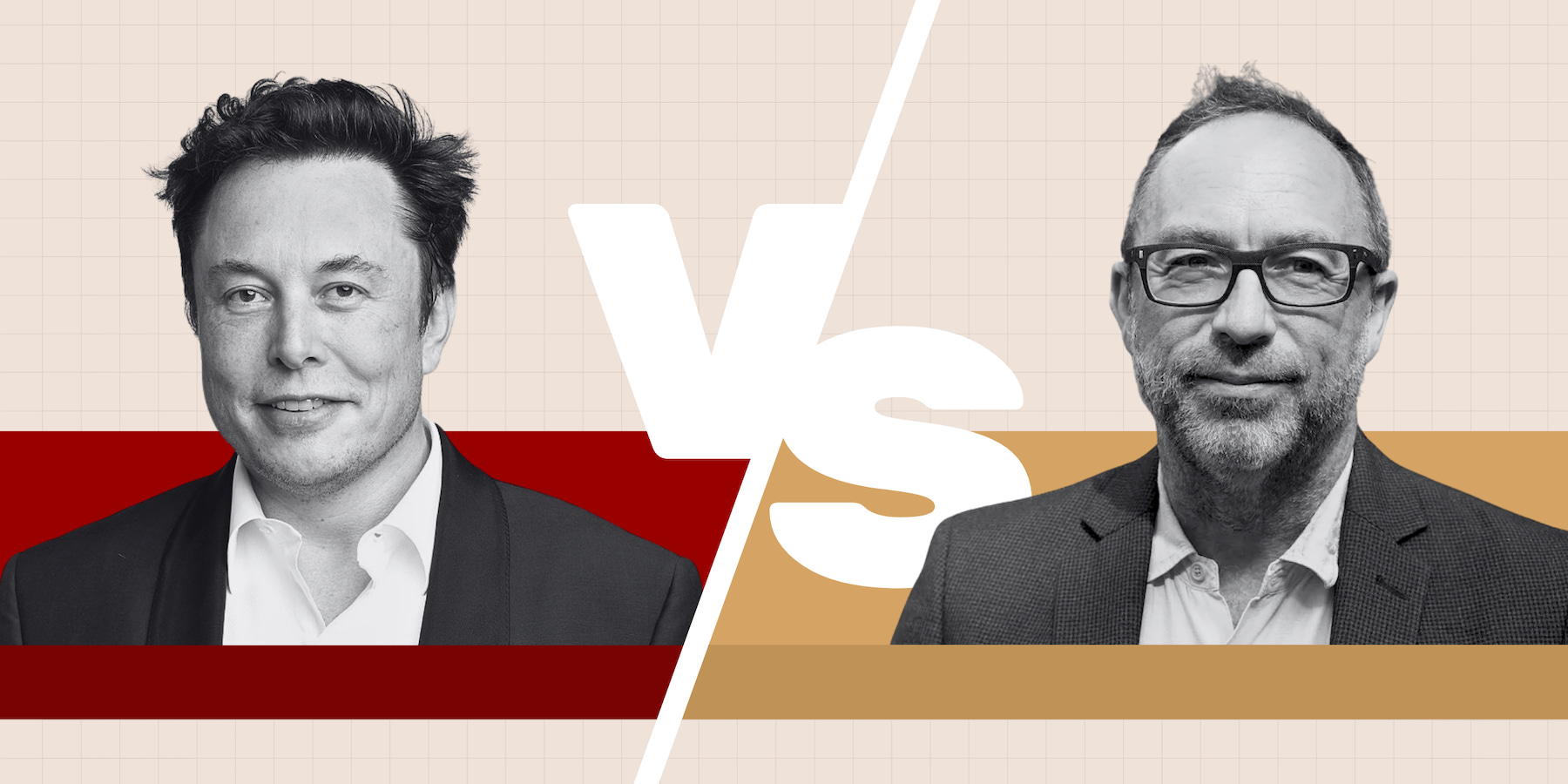
The great existential question of our age is, will my job be replaced by AI? Wikipedia editors have recently had reason to ask themselves this question, since Elon Musk finally made good on his longstanding joke-turned-threat to create an AI-powered online encyclopedia: Grokipedia, named for Grok, the large language model developed by his company, xAI.
Not so long ago, Musk was a normie appreciator of the internet’s default fact-checker—“Happy birthday Wikipedia! So glad you exist”, he tweeted unironically, when that was still the word for it, upon Wikipedia’s 20th anniversary in 2021. Since then, Musk has acquired the platform where he once posted that, undergone a one-man political realignment, gutted at least one federal agency, and started calling his once-beloved reference site “Wokepedia”.
Wikipedia has withstood many attempts to challenge its effective monopoly in online encyclopedias over the years, leaving would-be competitors nothing but ashes and 404 links, but Grokipedia is something different. When the world’s richest man steps onto your block, you’d best pay attention. But to understand why Musk wanted into the game, one must appreciate how the political and technological environments have changed, and why Grokipedia has a constituency in the first place.
In recent years and especially in the second Trump administration, Wikipedia has found itself in the same league with the mainstream media, academia, Big Tech, and international institutions as targets of a far-right movement that has displaced or captured more traditional center-right parties in Western countries, while putting the creaky liberal establishment on its heels.
As of 2025, an ascendant class of avowedly post-liberal counter-elites has come to power, unapologetic in its disdain for the erstwhile ruling class, armed with agentic tools capable of producing content and capturing attention at a scale unimaginable only a few years ago.
If Donald Trump is its lodestar, Musk is its vanguard, and Grokipedia his latest provocation.
Groksplaining
When Grokipedia launched in late October, the first thing everyone noticed was that it borrows from Wikipedia. Like, a lot. Many articles were simply copied over wholesale, as Wikipedia’s licensing allows. This occasioned no small amount of snickering—as much as Musk professes to hate Wikipedia now, even his own project can’t get off the ground without it.
The second thing was that significant areas, especially in politics, had been heavily modified to align with Musk’s recently acquired but strongly held worldview. As such, Grokipedia was received skeptically by the mainstream tech and news media, and with great enthusiasm by heterodox opinion entrepreneurs on Musk’s other website.
A deeper dive from researchers at Cornell Tech found that a little more than half of Grokipedia’s articles are near clones of their Wikipedia counterparts. Even substantially modified articles have more than 75% similarity to Wikipedia, but are often much longer, and highly concentrated in controversial topic areas (as defined by Wikipedia’s own list of such topics).
The study also found a nearly 90% increase in usage of what Wikipedia considers “generally unreliable” sources, including 42 citations to the Nazi website Stormfront and 34 to Alex Jones’s InfoWars—compared to Wikipedia’s grand total of zero for both. It also cites chat transcripts with Grok itself more than 1,000 times.
It’s the snake eating its own tail and asking for seconds.
Different Class
Grokipedia’s political commitments can be seen clearly by comparing how each encyclopedia covers the events in and around the U.S. Capitol building on January 6, 2021.
Wikipedia is unsparing: it describes the events as an “attempted self-coup” by Donald Trump and “insurrection” by his supporters; the very title calls it an “attack”. Grokipedia prefers more ambiguous terms like “riot” and “incursion”, emphasizing security lapses and intelligence failures among its causes, effectively blaming those who were trying to stop it. Where Wikipedia frames the events as gravely serious, leading to impeachment and numerous convictions—to be overturned in Trump 2.0—Grokipedia notes that sedition cases were few in number, and many charges were misdemeanors.
Wikipedia offers a confident assessment of what happened that day. Grokipedia considers the day’s events open to interpretation. But evading a conclusion is its own kind of bias. As Jeremiah Johnson of Infinite Scroll observes, “Nothing in the opening paragraphs is factually incorrect.” It just represents a different set of values, one self-consciously in opposition to the prevailing wisdom.
The same pattern appears elsewhere: pro-Kremlin framing of the Ukraine war, referring to transgender women as “biological males”, enumerating justifications for slavery while throwing shade at The 1619 Project, and omitting Musk’s role in dismantling USAID.
Grokipedia isn’t always 2+2=5 wrong. It’s just on the other side.
A Land of Contrasts
For all of Musk’s desire to replace Wikipedia, and despite his massive online fanbase—perhaps he knows something about their suitability for such a task—he has little interest in fostering a rival encyclopedia-building project, let alone the discipline to fully become the Bizarro Jimmy Wales. Instead, he has enlisted his wealth and the transformational technology of LLMs as a substitute.
Choices like these present clear tradeoffs compared to Wikipedia. As far as The Wikipedian can tell, there are four principal ways Grokipedia differs:
The first is its production model; Grokipedia is written by AI, Wikipedia is written by people.
Second is the governance model; on Grokipedia, Musk sets the terms for everything, while Wikipedia’s decisions are made collectively.
Third is process orientation; each has its biases, but Grokipedia is actively fixated on outcomes, while Wikipedia’s biases emerge from its systems.
Fourth is sourcing requirements; specifically which external sources each platform is willing to trust.
These elements reinforce each other—AI tilts toward centralization, which reinforces its benefactor’s perspective—but each represents a specific decision point where different combinations could exist. The pros and cons of each model are mirror images:
1. Production Model: Synthetic vs. Human
Being AI-written gives Grokipedia advantages in speed, scale, and comprehensiveness—and zero risk of burnout. If you want a particular topic handled consistently across many pages, AI will do this much better than humans. But it can misinterpret sources and invent plausible-sounding falsehoods, because it has no real awareness of what it’s saying.
Wikipedia being human-curated means real people making real choices. These editorial judgments improve both accuracy and accessibility: subject-matter experts bring context and nuance, while wordsmiths improve the reading experience. Contributors can have discussions and arrive at novel solutions an AI would be unlikely to predict. But they are vastly slower, have blind spots, hold grudges, and have topics they care about too much, or not enough.
2. Governance: Centralized vs. Distributed
Grokipedia is a case study in centralized planning. Musk’s developers will build exactly what he asks for (although not always perfectly). No consensus-building is required, nor endless debates about policy, and if you don’t like it, you know exactly who to blame. But it’s autocratic, having a single point of failure, and with no transparency into how decisions are made. Don’t expect passionate users, because there’s no meaningful way to get involved. There will never be such a thing as a Grokipedian.
Wikipedia’s distributed model bestows greater legitimacy, benefiting from passionate contributors from different backgrounds who can catch errors, reconsider past decisions, and make the project resistant to capture. On the other hand, participatory governance can be exhausting, and Wikipedia suffers from the tyranny of the committed: those with the most time often get their way. Wikipedia is also far harder to join today: new editors face a bewildering maze of policies, customs, and norms, and so much has already been done.
3. Orientation: Partisanship vs. Pluralism
I’m deducting points from Grokipedia here because it refuses to admit the project is a partisan one. This self-delusion is not unique: the temptation to declare oneself objective and everyone else biased is universal. But the fact is Grokipedia exists to serve a vocal minority who disagree with Wikipedia’s conclusions on a narrow range of topics. This can be a good thing—serving audiences that feel excluded elsewhere is the market in action. But there’s no denying Grokipedia explicitly prioritizes its creator’s ideological agenda over truth-seeking. It’s less of an encyclopedia, and more a simulacrum of one. If Wikipedia is biased, Grokipedia just flips the script—and pushes too far in the other direction.
Wikipedia tries to represent all significant views in proportion to their real-world import. As such, it’s generally considered a reasonable source for most subjects, and is useful for settling disputes. It is pluralism in action: no one person or perspective will get everything right, so the best we can hope for is multiple viewpoints converging on a better result. But someone unhappy with the outcome is unlikely to appreciate the process that got there. And when the process is followed, whatever the outcome, its participants often simply shrug.
4. Sourcing: Permissive vs. Selective
Perhaps Grokipedia supporters’ most appealing argument is that Wikipedia’s exclusion of certain publications makes it less inclusive. Grokipedia’s supporters will argue that less restrictive sourcing allows more detailed articles by permitting sources that Wikipedia discounts. It boosts “citizen journalism” against the out-of-touch establishment, and surfaces information that doesn’t serve elite interests. But its lack of rigor also leads to citing Nazis, and laundering propaganda as “another perspective”. To critics, this is naïve, if not a loophole designed to elevate fringe views.
Wikipedia’s sourcing standards prioritize quality control over completeness. Privileging sources with fact-checking, editorial oversight, and independence from the subject improves accuracy, professionalism, and impartiality. Of course, all the same caveats about elite capture and structural biases remain. Wikipedia’s selectivity in sourcing is its real soft underbelly.
Machine Learnings
None of which is to say Grokipedia has nothing to teach Wikipedia, which even its strongest supporters can sometimes acknowledge has become risk-averse and inertial. No doubt, it has many laurels on which to rest. But perhaps it has become a little too comfortable. Many things about it are worth criticizing, but without a visible alternative, it’s hard to articulate what a different world could look like, much less find motivation to do the hard work of bringing it about. If for that reason alone, Grokipedia’s arrival could be good for Wikipedia. Everyone needs a little competition to stay sharp.
Take Wikipedia’s neglected topics—a downside of its incredible 7 million article count is that many are underwhelming at best. As Katie Notopoulos at Business Insider observed, on obscure topics, Grokipedia sometimes produces more satisfying overviews than Wikipedia’s unloved entries “where it truly seems like a bunch of people added in a single sentence once a year for the last 15 years.” It’s heresy today, but perhaps the speed and scale that AI affords could be harnessed to solve these problems.
Wikipedia editor Ryan McGrady suggests taking lessons from Grok’s sourcing approach where the value of additional context outweighs the risk of self-serving claims. For journalists, welcoming primary sources “could draw information about the person and their work from their own writing, and it would remain more up to date than articles that have to wait for a secondary source.”
The Wikipedian has another lesson in mind, based on Grokipedia’s lone interactive element: a three-field form for suggesting changes. If you know what you’re doing on Wikipedia—and aren’t too close to a subject to trigger conflict of interest concerns—you can make a change instantly. But only a very few will ever try. Wikipedia’s infrastructure still assumes everyone could become an editor, a notion long past its expiration date. Even those who figure out the Talk page face response times far slower than on Grokipedia, which now reviews suggestions within minutes—not to oversell the experience, you’re still petitioning an algorithm. If Wikipedia enabled such a mechanism, it could turn editors into a team of fact-checkers—which to some extent is what its process-oriented, long-term contributor base wants to be anyway.
Predictive Modeling
As yet, Grokipedia has not seriously challenged Wikipedia’s popularity or position. Search interest in Grokipedia peaked in the first two weeks after its announcement, then fell off hard, while Wikipedia continues to be sought out by orders of magnitude more. As of mid-December, Wikipedia remains the top organic search result for “elon musk” on Google, while Grokipedia is nowhere to be found in the first ten pages of results.
Musk has the advantage of technology, which will keep it in the game. It may even become the world’s largest encyclopedia, since it can keep churning out pages without so much as a coffee break. But technology will only get you so far. The Wikipedian would be surprised if it captured significant market share beyond its built-in audience; Wikipedia is more than good enough for the great silent majority who just want to check one thing and go on with their day.
Grokipedia is also unlikely to replace Wikipedia in the tech industry. While Musk has declared Grokipedia free to use “at no cost”, it’s unclear what that really means, whereas Wikipedia’s commercial-friendly licensing has already made it a resource tech firms are happy to use. Even if Musk does clear this up, companies like Google, OpenAI, and Anthropic have strong business reasons not to use it—particularly that Grokipedia is owned and operated by a competitor.
It’s also very possible Musk simply loses interest, having made his point, with a trillion-dollar pay package from Tesla pulling his attention, to say nothing of his stated plans to move to Mars.
Grok Will Not Replace Us
Wikipedians probably don’t have to worry about being replaced outright. Grokipedia’s production model forecloses the possibility of a rival movement, its governance is anathema to the read-write web, its perspective limits its broad-based appeal, and its anything-goes sourcing undercuts its credibility.
Unfashionable though it may be to say, values matter, and not every set is equally conducive to the task at hand. Sooner or later, the intent behind the project will have consequences, and the fact remains that Grokipedia is rather transparently a spite house of a website reflecting the worldview of a single man, no matter how rich, whose reputation and run of decisions will ultimately limit its appeal. Wikipedia may be written by a “bunch of nobodies”, but if you put enough nobodies together with the right set of values making the right editorial choices, and even the most self-obsessed somebody the world has ever seen is no match.
Still, the best possible encyclopedia would take advantage of both: humans leading the way, supported by AI. Wikipedia is great, but not as great as it can be. The development of generative AI is a very real hinge point in the history of information, one equal parts exciting and terrifying, as all hinge points are, and Wikipedia risks obsolescence only if it lets the moment pass by.
If Grokipedia sustains growth, it could mark the first serious challenge to Wikipedia’s dominance in two decades. But the deeper story is about control of knowledge: who gets to define neutrality, and whether a platform born from Musk’s ecosystem can truly become the world’s reference library.
This isn’t just about traffic. it’s about whether the future of collective knowledge will be crowdsourced, corporate, or something in between.